
Answering one question properly.
Dogs Invited started with a simple frustration: dog beach information gets passed from site to site until it no longer matches the sign on the sand. The brief was a guide that answers the one question that decides the day, whether your dog is allowed on that beach, and answers it from the document that creates the rule.
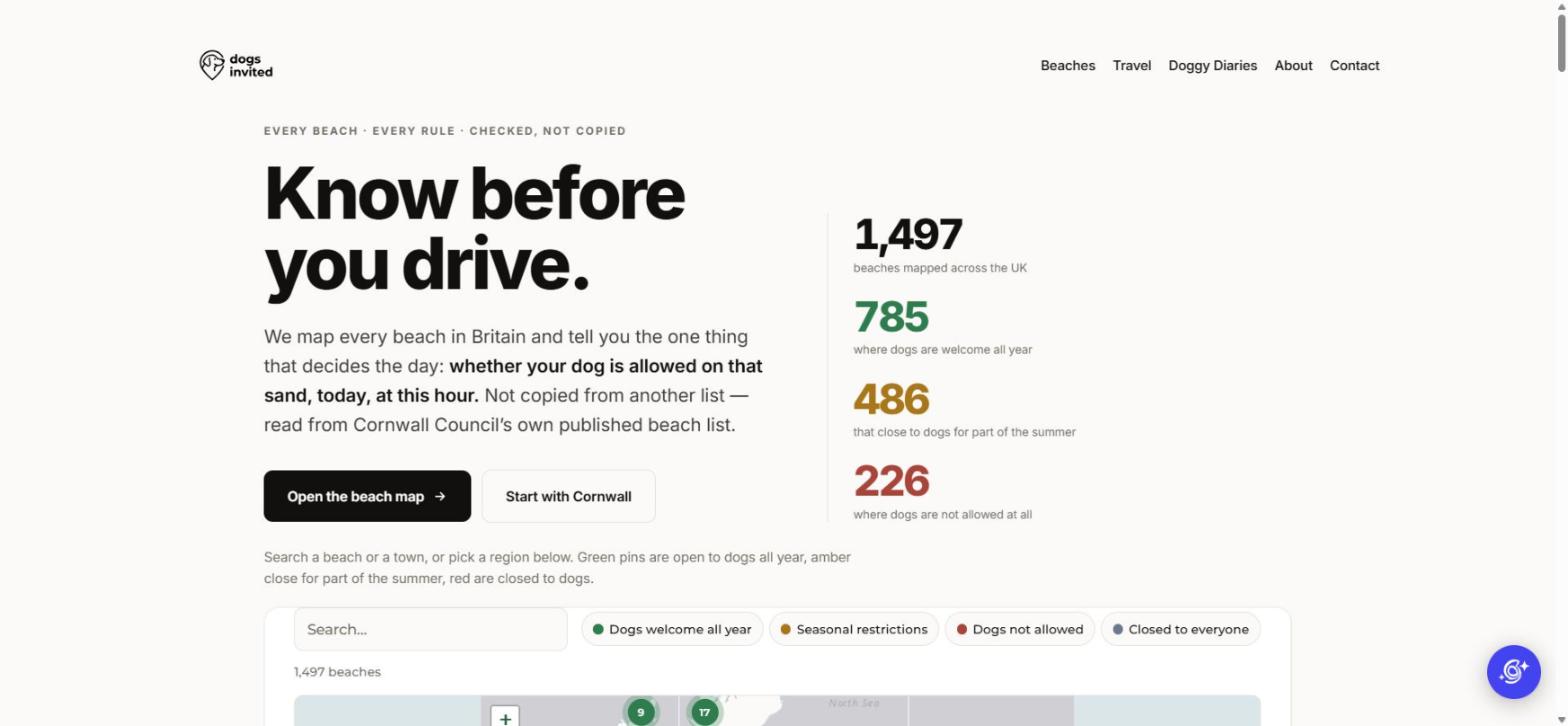
We built the site so the answer comes first. A map with Near me search shows every beach as a green, amber or red pin, and each written guide leads with a verdict card before anything else. That is the whole product: a fast, honest answer, then the evidence behind it.
Reading the order, not the sign.
In England and Wales a beach dog restriction is created by the local council as a Public Spaces Protection Order. It names the beach, the dates, the hours and often the exact stretch of sand. Most websites summarise these once and move on. Dogs Invited goes back to the order itself, then looks for the second authority, because a harbour, a trust, an estate or the National Trust can set rules that never appear on a council list.
The work is slow and it finds things. Cornwall’s 2026 dog order has 48 line items, not the 43, 46 or 49 that different council pages quote. When it was read in August 2026, the council’s own webpage disagreed with the order in six places. In two of them the order restricts a longer stretch of coast than the webpage says, and Polruan and Summerleaze appear on the webpage but not in the order at all.
A map that is honest about where things are.
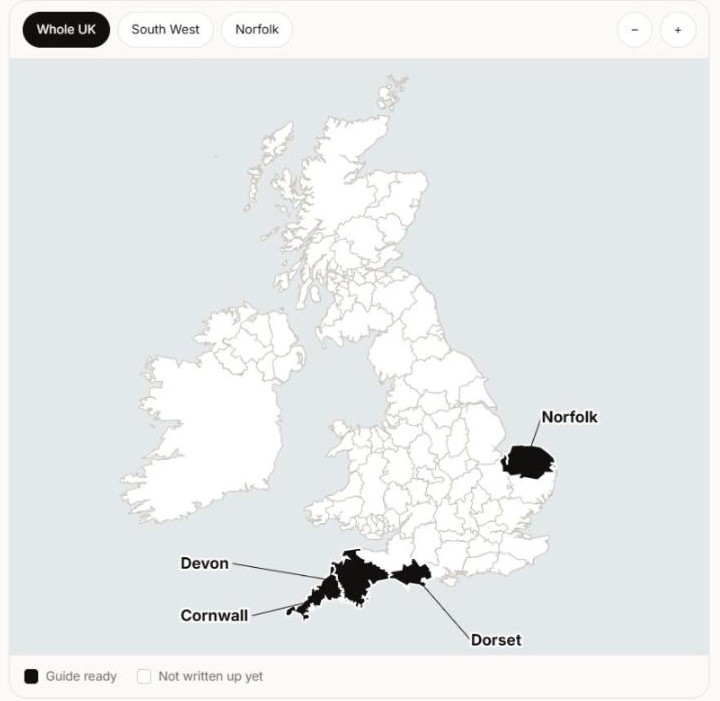
The map is the front door. Every beach is a pin coloured allowed, seasonal or banned, searchable by postcode, town or beach name, or with Near me. Behind it, every beach carries its own coordinates, and every label sits on a place that really is there.
An early version of the printed guide labelled maps by postal town. That stretched one label across 22 kilometres of the Lizard and put Newquay and Perranporth under one name. A script now measures every label on every rendered map, because text placed by coordinate has no layout engine to complain when it overlaps.
Now the map has a globe.
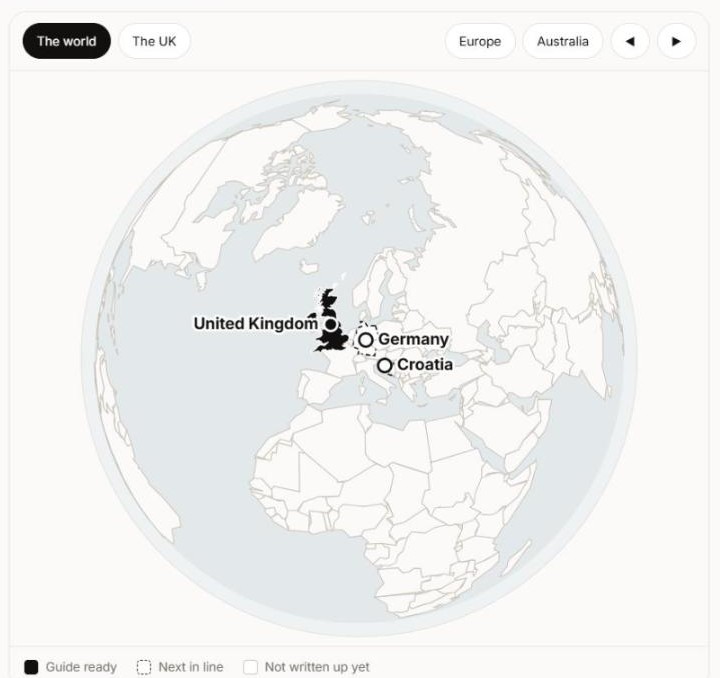
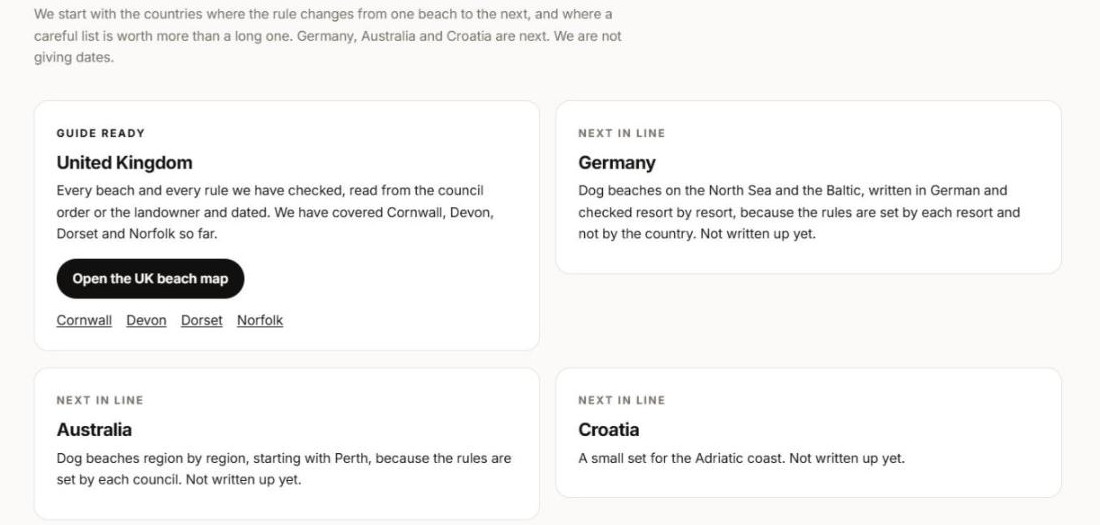
The home page is now a world map. Dark means a country is written up and checked, dashed means it is next in line, and pale means we have not got there yet, which is not the same as dogs being banned. Today the United Kingdom is the only dark country. Germany, Australia and Croatia are next, and the site says plainly that there are no dates.
Starting somewhere new means starting the research again. In the UK the rule comes from a council order. In Germany it is set resort by resort, and in Australia council by council, so each country needs its own sources and its own checks before anything is published. The map is honest about that gap rather than hiding it.
Built quickly, checked slowly.
The pages are generated from one researched dataset through templates, so a verdict card, a twelve-month year strip, a parking block and a facilities grid look and behave the same on every beach. People call that programmatic SEO. The difference here is that every row in the dataset is read from its source before it is allowed near a template.
AI does the heavy lifting on drafting, extraction and formatting. It does not decide what a rule says. Each cluster of beaches gets a research file covering the beaches, rules, orders, sources and conflicts, and a checker script has to pass with zero errors before anything is built from it. Five Kent council areas and sixty beaches went through that process in a single long working session. The output is tested too: page geometry, voice, engagement and a logged-out fetch of the live page.
Built to be quoted, not just found.
Before a page is written, its whole search cluster is read in Semrush, the head phrase and everything beneath it, so no two pages compete for the same words. dogsinvited.com started from a clean zero, with no keywords and no traffic, so everything it earns is attributable. The main phrase, dog friendly beaches, draws about 4,400 UK searches a month at a difficulty of 16 out of 100 (Semrush, 9 October 2026). The Kent dog beach family alone measured 154 keywords and 2,900 searches a month at a difficulty of 9 (29 September 2026).
An earlier version of the guide showed where the weight sits: about 59 per cent of its visits came from near-me searches. So the Near me button is not decoration. It is the search strategy turned into an interface.
Written so AI search can cite it.
Every guide leads with one verdict that a person or an AI answer can lift as it stands, followed by the source it came from. Each page carries one named author, a visible FAQ and structured data that matches the words on the page. Where a rule is reported but cannot be confirmed, the page says so, because an answer engine that quotes a guess damages the site that supplied it.
From web page to something you can print.
Dog owners print a county’s rules before a trip, so each county gets a printable guide for £5. The Cornwall edition is a 24-page A5 book plus a two-page A4 print-out with every beach and one answer each. The guides are built from the same rows as the web pages, so print and page agree by construction, and a check measures the rendered PDF rather than trusting that it fits.
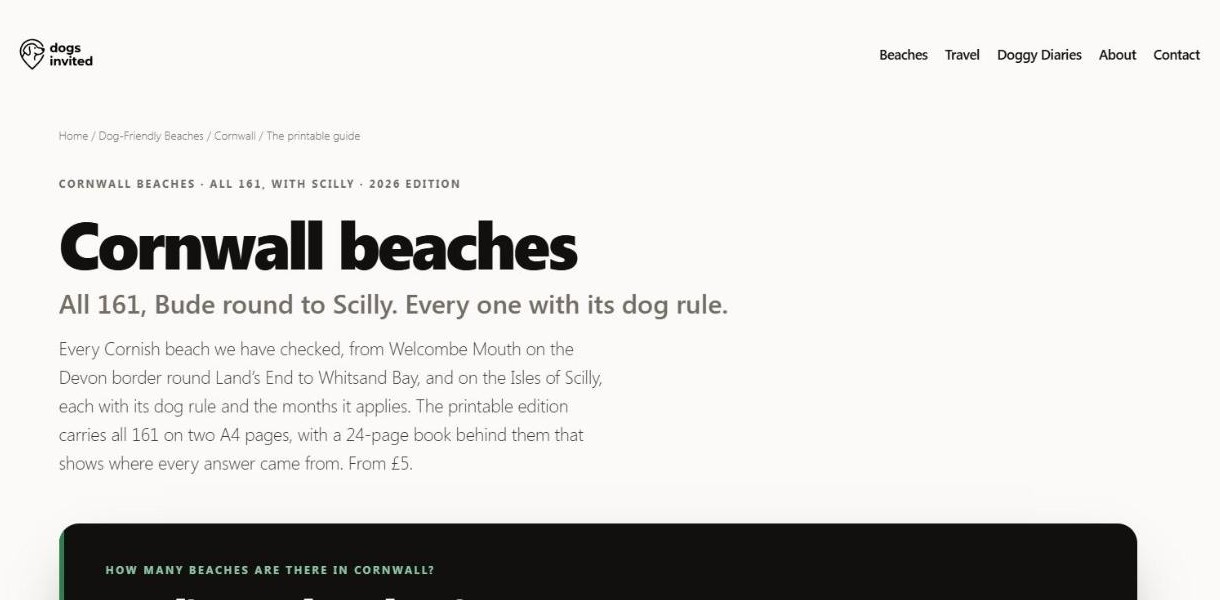
The Cornwall guide page sells it plainly: all 161 beaches, from Bude round to Scilly, on two A4 pages, with the 24-page book behind them that shows where every answer came from. Devon, Dorset and Norfolk each have a county guide page on the site too.
What this means for your own site.
Most small businesses do not need 1,400 pages. They do need the same habits: one question answered first, claims that can be traced to a source, a set of pages that each own a different search, and structure that search engines and AI answers can read. The same method scales down to a three-page site. See how I price it on the services page, or ask for a free website review.