
A site that had to say one thing clearly.
Equine Escapes began as an animal holidays site that mixed farm stays, dog beaches and horses. In September 2026 it became a horse holidays site, and the dog beach side moved to its own site, Dogs Invited. Farms and dogs were selling different things to different people, and the site was confusing both.
The brief was to say one thing plainly: horse holidays across the UK and around the world, plus a proper home for the owners’ own two holiday lets. We rebuilt the site around that, and the booking system had to carry on working throughout.
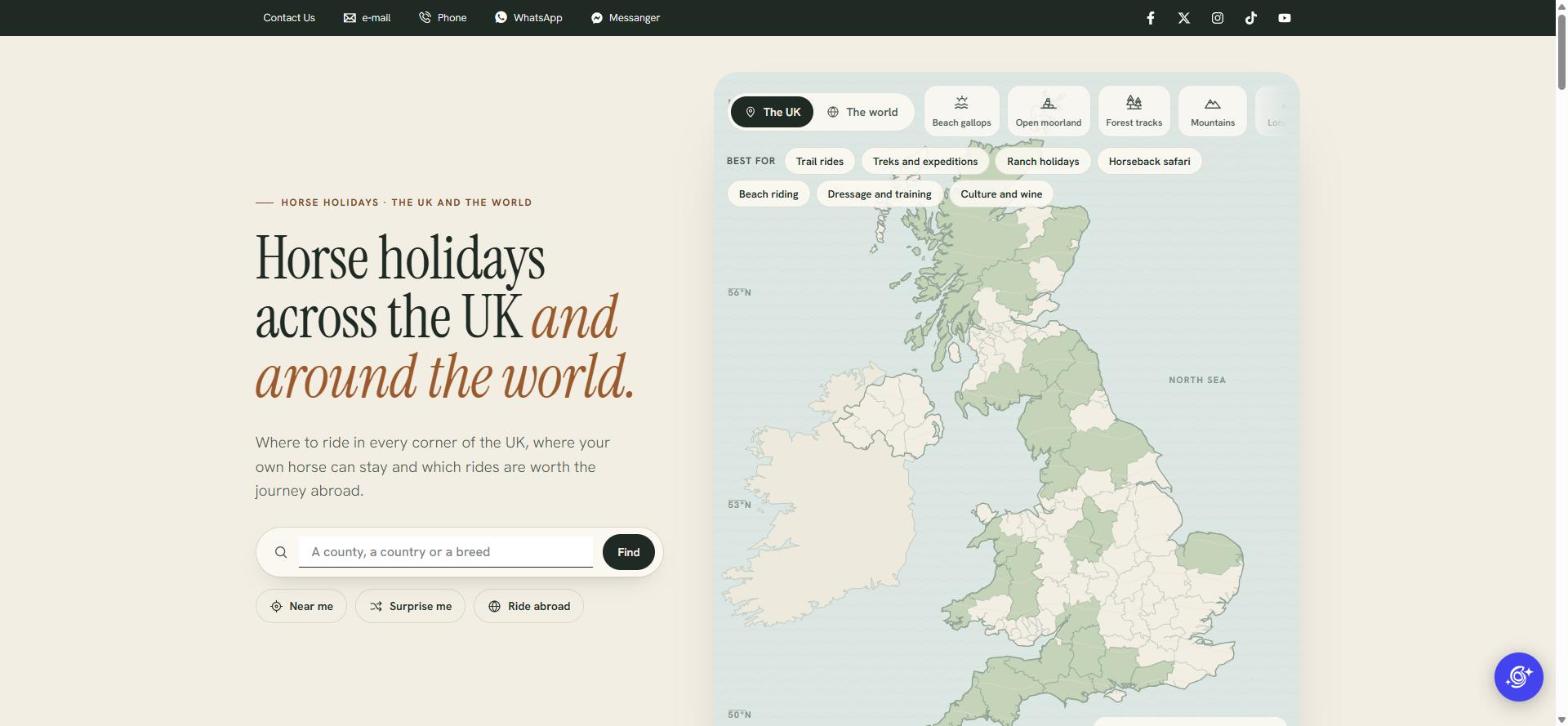
A map and three ways in.
The home page is a map. Visitors can use Find near me, Surprise me or Ride abroad, switch between the UK and the world, and filter by landscape: beach gallops, open moorland, forest tracks, mountains, long trails, ranch and western, or safari. A second set of filters works by what the holiday is best for, from trail rides and treks to ranch holidays, beach riding, dressage and training, and culture and wine.
The site now has 71 pages and 15 news posts, each aimed at a different question a rider would actually ask, and each owning its own search phrase so the pages do not compete with each other.
Take your horse.
A second front door serves riders who want to bring their own horse. It is a directory of places that take a guest’s horse, built to be open to other owners’ properties from the start. The two holiday lets on the farm are entries one and two, each with its own page and its own address, never both squeezed on to one page.
A site that expects to grow needs a structure that does not break when entry three arrives, so every entry uses the same template and the same facts in the same order.
One calendar, every platform.
The two lets are listed on several booking platforms at once, which is how most bookings arrive. The risk is a double booking, so the site runs one calendar per property, kept in step with the platforms through a channel manager. A night taken on one comes off the rest.
The site’s own booking tool is a request form rather than an instant checkout. The lets are fitted around the family’s own dates, so the owner confirms each stay and invoices directly. It is a deliberate choice, and it keeps the page honest: it says request, never instant book.
Small sites that can be found by name.
Each property also has its own small booking site, so it can be found by name in search, including Google’s holiday rental results, rather than only inside a platform listing. The aim is a route to guests that does not hand a commission to a platform every time.
A booking tool is only worth having if people can find it. Every page carries one named author, a visible FAQ and structured data that matches the words on the page, so search engines and AI answers can read the site as easily as a visitor can.
What the search data says.
The case for a booking-focused page is small but clear. In Semrush (UK, 9 October 2026), “wordpress booking calendar” and “booking calendar for website” each draw about 50 searches a month, and the second carries one of the highest advertiser values of the phrases I checked. These are people who already know they need one. We have not yet measured the horse holiday phrases the site itself is built around, which is the next read.
That is why this page is about the booking calendar and not the horses. The horses have their own pages, and each of those owns its own phrase.
An animal lovers’ site.
Equine Escapes is for people who love animals, so the imagery follows one rule: photographs show people riding or the riding area, never spectacle. For rides abroad the site helps a visitor choose a ride and introduces them to a specialist operator who runs it. The site stays behind Cloudflare for speed and protection.
What this means for your own site.
If your business takes bookings, the questions are the same at any size. Do you need dates kept in step with other platforms, or is a request form enough? Does each property or service deserve its own page and its own search phrase? Can a visitor find what they want from a map or a filter? We build and price those decisions on the services page, or you can ask for a free website review.